



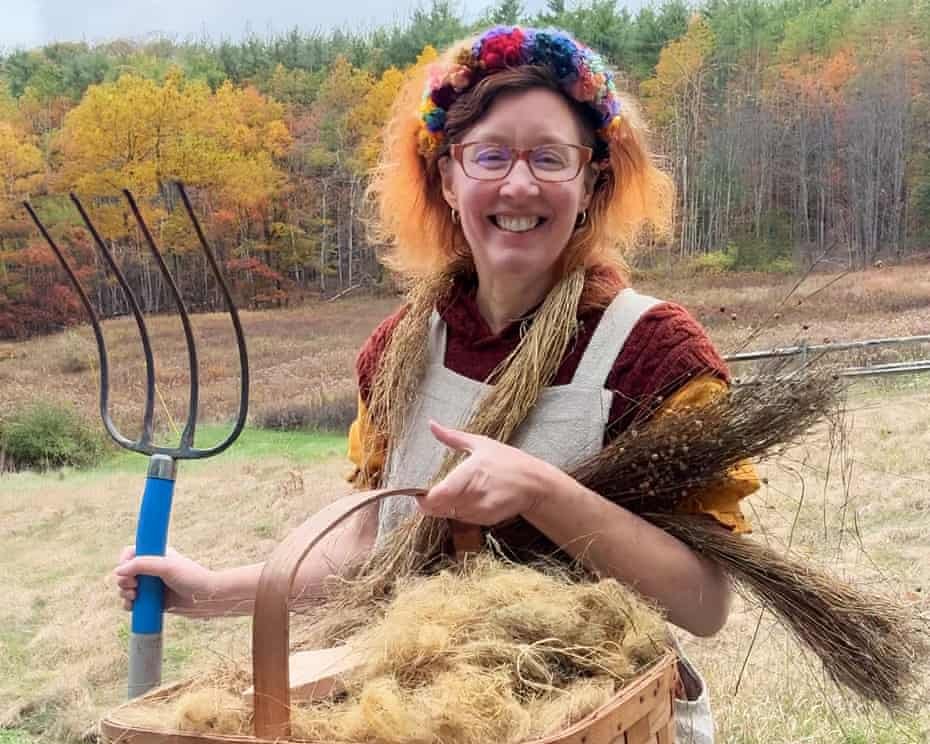
Slow fashion usually means buying fewer clothes, choosing better-quality pieces and thinking more carefully about how garments are produced. For Eve Ogden Schaub, however, the idea has become much more ambitious: she decided to grow the raw material for her own dress.
The Vermont-based maker is attempting to create a linen garment starting with flax seeds planted in her backyard. The unusual project is her personal response to the speed, waste and environmental costs associated with modern fashion.
Growing a Dress From the Ground Up
Schaub began the experiment in April 2025, transforming a roughly 600-square-foot vegetable garden into a flax-growing plot.
After harvesting her first crop, she planted a second. But growing flax was only the beginning. Turning the plants into something wearable requires a long series of traditional textile processes.
The harvested flax has to be retted, a controlled decomposition process that helps separate the useful fibres. It then goes through breaking, scutching and hackling before the fibres can be spun into yarn.
Eventually, Schaub hopes to weave that yarn into fabric and sew it into a dress.
Slow Fashion Takes Patience
The project highlights just how much work is hidden behind an ordinary piece of clothing.
Today, consumers can browse thousands of garments online and have something delivered within days. Schaub’s experiment moves at the opposite speed. Every stage requires time, physical effort and new skills.
She has had to learn from textile experts and enlist family and friends along the way. Spinning, in particular, has proved challenging, with mistakes becoming part of the learning process.
That difficulty is precisely what makes the experiment meaningful.
Questioning Fast Fashion
Schaub’s project is also a criticism of the fast-fashion system.
Cheap clothing has made fashion more accessible and convenient, but its environmental and human costs have become increasingly difficult to ignore. Textile waste, synthetic fibres and poor working conditions are among the concerns surrounding the global clothing industry.
By producing a garment almost entirely from scratch, Schaub wants people to consider what lies behind the price tag of a piece of clothing.
The experiment also offers a different definition of value. A dress that takes months or years of work to create naturally feels very different from an inexpensive garment bought on impulse.
Rediscovering the Value of Clothes
Interestingly, the project has changed Schaub’s own relationship with fashion.
She says she is now less attracted to department-store clothing and more interested in appreciating and repairing the garments she already owns.
The reaction from people following her journey online has also been revealing. Some viewers have said that watching the process helped them understand why clothing was historically expensive and why people once owned relatively few outfits.
When making fabric requires this much effort, the value of every piece becomes obvious.